 Dainik Nation News Portal
DAINIK NATION BUREAU/DEHRADUN
In a bid to boost aroma cultivation in state, Chief Minister Pushkar Singh Dhami has officially launched the Uttarakhand Aroma Revolution Policy 2026–36 here in Dehradun on Saturday. In his address CM Said that it is a historic step towards enhancing farmers’ income and strengthening the rural economy of the state.
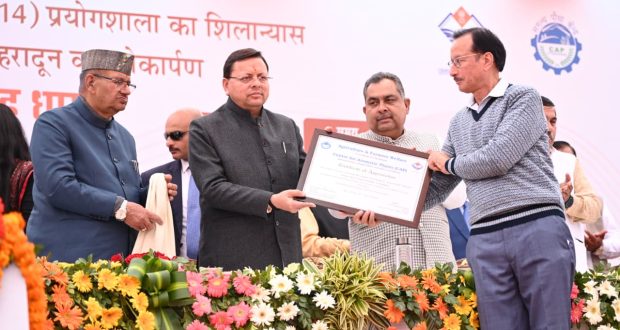
On the occasion, the CM Dhami also inaugurated the Satellite Centre at Bhauwala and laid the foundation stone of the AMS (C-14) Laboratory at the Aromatic Plant Centre, Selaqui. He also laid foundation stones for a total of five satellite centres, to be established at Parsari (Chamoli), Raithal (Uttarkashi), Bhaisodi (Almora), Khatera (Champawat) and Vishad (Pithoragarh).
During the programme, a Memorandum of Understanding (MoU) was signed between the Aromatic Plant Centre and Dabur India Limited to promote collaboration in extension services, research and development, human resource development and marketing. The MoU was signed in the presence of Director, Aromatic Plant Centre, Shri Nripendra Singh Chauhan, and Executive Director, Dabur India Limited, Dr Saurabh Lal.
The Chief Minister also honoured the founding scientists of the Aromatic Plant Centre and farmers engaged in the cultivation of lemongrass and basil. He later visited the perfumery laboratory and interacted with scientists and farmers.
Addressing the gathering, CM Dhami said that under the Aroma Revolution Policy, seven aroma valleys will be developed in the state. In the first phase, Timur Valley (Pithoragarh), Damask Rose Valley (Chamoli and Almora), Mint Valley (Udham Singh Nagar), Cinnamon Valley (Champawat and Nainital) and Lemongrass and Mint Valley (Haridwar and Pauri) will be developed. The policy includes provisions for nursery development support, cultivation subsidies, training and capacity building, crop insurance, as well as packaging and branding.
He said the policy aims to bring aromatic crop cultivation to nearly 23,000 hectares of land and connect around one lakh farmers across the state. Over the next ten years, the government targets increasing the turnover from aromatic crops from ₹100 crore to around ₹1,200 crore, significantly boosting farmers’ income and the state’s economy.
Highlighting farmer welfare initiatives, the Chief Minister said that under the leadership of the Prime Minister, the state government is working continuously for the prosperity of farmers. Farmers are being provided interest-free loans up to ₹3 lakh, subsidies of up to 80 percent under the Farm Machinery Bank scheme, a ₹20 per quintal bonus on wheat procurement, and an increase of ₹30 per quintal in sugarcane prices. Irrigation through canals has also been made completely free.
He further informed that ₹200 crore has been provisioned for polyhouse construction, under which about 350 polyhouses have already been established with assistance of nearly ₹115 crore. To support rain-fed farming in hilly areas, the Uttarakhand Climate Responsive Rain-Fed Farming Project worth approximately ₹1,000 crore has been approved. The government is also working at multiple levels to enhance fruit production in the state, similar to its initiatives in vegetable cultivation.
Senior officials, scientists, farmers and representatives from Dabur India Limited were present on the occasion.
